

Disclaimer: This page contains content specific to Florida Stem Cell Law, which permits specific licensed physicians to administer stem cell therapies not yet approved by the U.S. Food and Drug Administration. This content applies to providers licensed in Florida under Chapter 458 (Medical Doctors) and Chapter 459 (Osteopathic Physicians) acting within the scope of their practice.
Extracorporeal Shockwave Therapy (ESWT) is a non-invasive regenerative intervention that administers focused acoustic energy to damaged tissues to promote the body’s inherent repair mechanisms. Initially developed for the fragmentation of kidney stones via lithotripsy, this technology has since evolved into a well-researched modality for chronic musculoskeletal conditions — notably tendinopathies, joint inflammation, and soft tissue injuries.
Instead of suppressing symptoms, shockwave therapy operates by administering controlled mechanical pulses directly into damaged tissue. These pulses induce microscopic stimulation, thereby promoting biological repair processes. In cases of chronic conditions where natural healing has stagnated, this mechanical signaling can reactivate the body’s intrinsic recovery mechanisms. Extracorporeal Shock Wave Therapy (ESWT) is often regarded as an intervention when conservative measures, such as rest, anti-inflammatory medication, or physical therapy, have failed to produce sustained improvement.
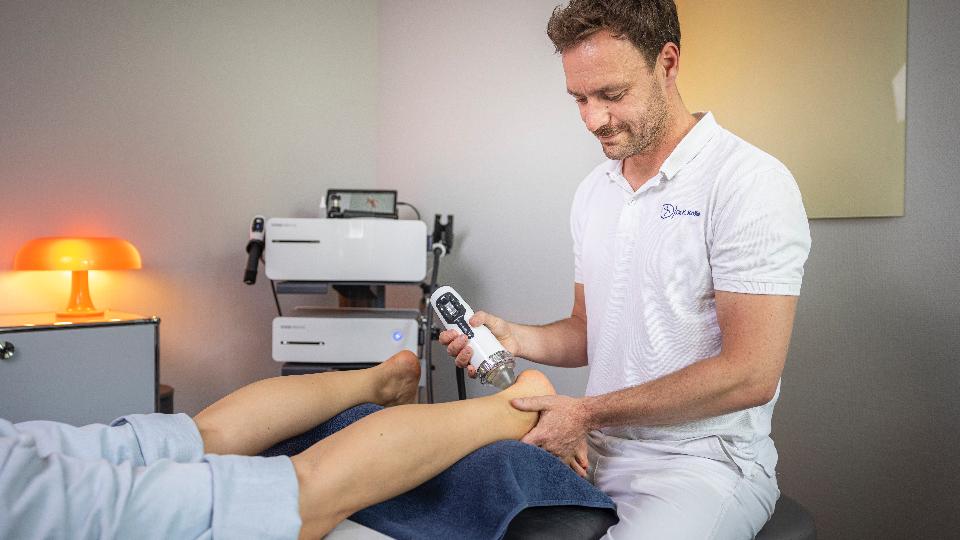
Shockwave therapy impacts tissue repair via mechanical and biological mechanisms. When acoustic waves traverse the skin and underlying tissues, rapid pressure variations induce controlled micro-stimulation within the tissue. This process triggers a targeted inflammatory response essential for regeneration in chronically irritated or degenerative regions where active healing has halted.
Fibroblasts—the cells responsible for collagen synthesis—are activated by this stimulation, thereby supporting the structural reinforcement of tendons, ligaments, and connective tissue. In regions with impaired circulation, shockwave therapy encourages angiogenesis, thereby enhancing oxygen and nutrient delivery to the affected tissues. Additionally, shockwave pulses disrupt fibrotic tissue and calcific deposits, which may contribute to stiffness or chronic discomfort, and modulate local pain signaling pathways and improve tissue metabolism.
Mechanism of Action in Shockwave Therapy: Shockwave therapy exerts therapeutic effects through multiple biomechanical and cellular pathways, leading to faster recovery and improved patient satisfaction.
Shockwave therapy produces therapeutic effects through multiple biomechanical and cellular pathways:
Clinical research supports these mechanisms. For instance, Gerdesmeyer et al. (2008) demonstrated that ESWT significantly improved pain and function in patients with chronic plantar fasciitis compared to placebo, establishing it as a first-line treatment option.
Delivers concentrated energy to deeper tissue structures. It is typically employed for chronic tendon injuries, calcific deposits, and deeper joint-related irritation where targeted penetration is clinically indicated.
Disperses energy across a broader surface area. It is commonly used for plantar fasciitis, superficial tendon irritation, muscle tightness, and soft-tissue dysfunction. Although less penetrative than focused shockwave therapy, it effectively enhances circulation and diminishes localized inflammation in superficial structures.
Shockwave therapy is conducted in a clinical setting and obviates the need for anesthesia or surgical preparation. A handheld applicator administers acoustic pulses to the specified area during a short treatment session. The majority of patients tolerate the procedure well; however, some may experience mild discomfort depending on tissue sensitivity and the treated region.
Following treatment, some patients experience transient soreness that usually resolves within a few days. As ESWT stimulates the body’s repair mechanisms, gradual improvement typically occurs over several weeks as collagen remodeling and vascular alterations take place. The majority of treatment regimens incorporate multiple sessions distributed over several weeks to maximize results.
Unlike stem cell or exosome therapies, shockwave therapy does not introduce biological material into the body. Instead, it employs controlled mechanical stimulation to activate innate repair mechanisms. In certain clinical contexts, ESWT may be used as a standalone treatment. In contrast, in others, it may complement regenerative biological therapies such as PRP, depending on tissue condition, injury chronicity, and specific clinical objectives.
Traditional methods for managing chronic tendon and joint pain commonly involve the use of anti-inflammatory medications, corticosteroid injections, bracing, or surgical procedures in severe cases. Shockwave therapy distinguishes itself by directly addressing the biological repair mechanisms, rather than merely suppressing inflammation. Although steroid injections may offer temporary symptom relief, they do not promote collagen regeneration. Extracorporeal Shock Wave Therapy (ESWT) seeks to transform persistent, stagnating tissue irritation into an active healing response, thereby fostering long-term structural recovery rather than merely alleviating discomfort.
Not every patient or condition is an ideal candidate for shockwave therapy. A comprehensive clinical assessment—including a physical examination and, when appropriate, a review of imaging—is essential to determine the condition’s suitability for mechanical stimulation therapy. Patients with specific circulatory disorders, active infections, or other medical conditions require a personalized evaluation before proceeding.
Shockwave therapy is not a universal solution. It is most effective when incorporated into a comprehensive treatment plan that may encompass physical therapy, activity modification, and other regenerative approaches—customized to the severity, chronicity, and unique requirements of each patient.